The Skim Tax
The Skim Tax is the cumulative cost of skimming AI output instead of working it through. Paid in two currencies, quality now and capability later, and by two parties: you, and everyone who depends on the work that goes out under your name. This was named and refined through ChangeSchool’s work with senior leaders across our executive education programmes, as part of the modular blocks of our Deeper Work with AI curriculum.
Three errors caught in the first eight minutes of your board meeting: a wrong revenue figure, a stale competitor name, a misquoted statute. The AI-drafted paper had been read once at speed, not worked through. Those three errors were the visible tip; the Skim Tax is what the rest of the bill costs, running invisibly all week and across the institution.
The Skim Tax framework
Skimmed AI use carries a hidden tax, fourteen costs across four quadrants.
Two axes: per-interaction versus compounding, individual versus organisation. Fourteen named taxes distributed across the four quadrants.
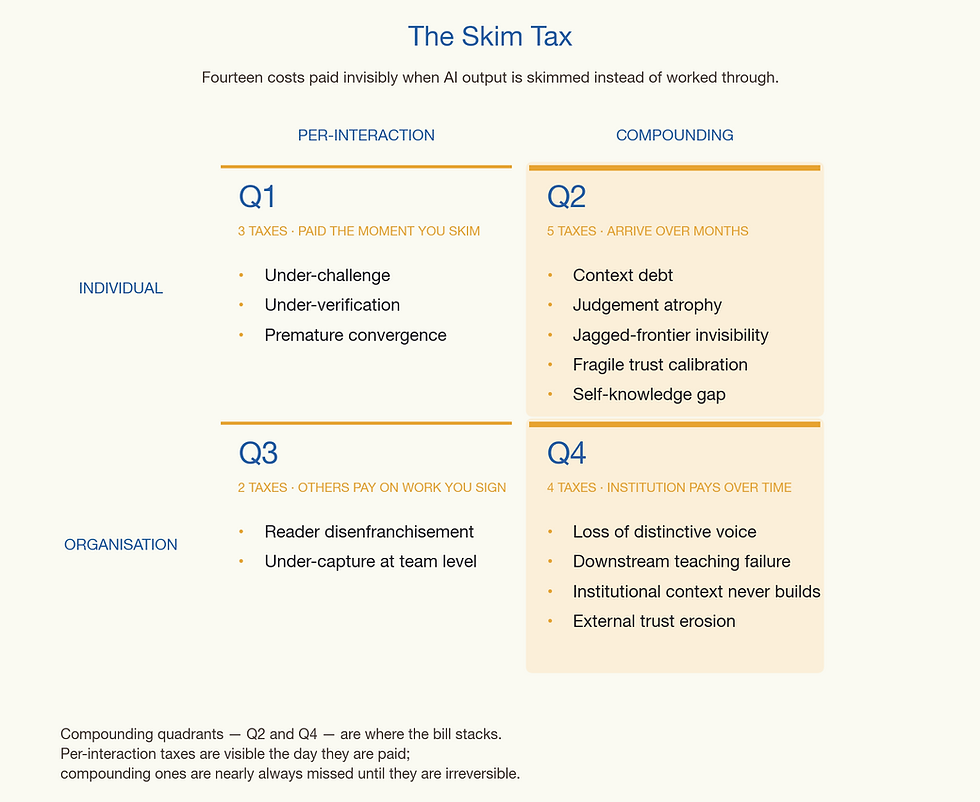
The Skim Tax matrix, two axes (per-interaction / compounding × individual / organisation) and four quadrants Q1–Q4 listing fourteen named taxes. The compounding column (Q2 individual-compounding, Q4 organisation-compounding) is tinted ember to mark the heavier-bill quadrants where compounding taxes accrue invisibly until irreversible.
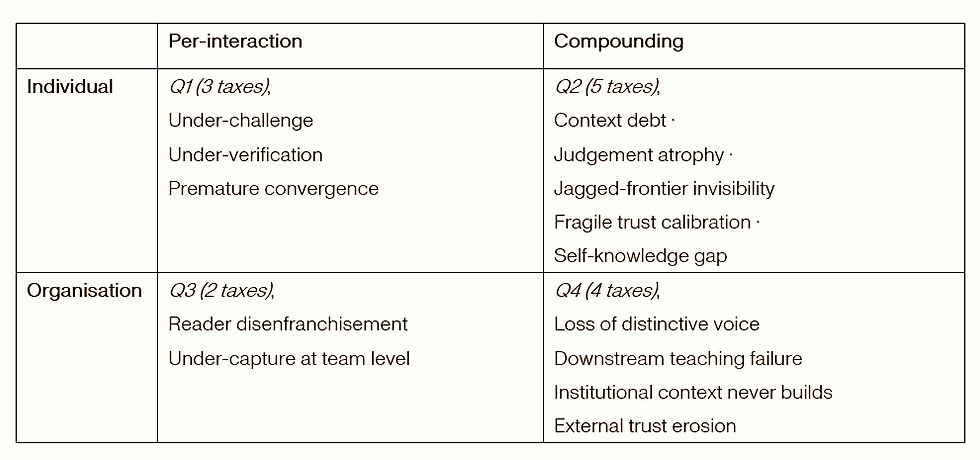
Fourteen taxes in total. Three in the moment, five across your career, two on each piece of work you sign, four on the institution, compounding across years.
Quadrant 1: Individual, Per-interaction
Taxes paid the moment you skim.
-
Under-challenge, the first plausible answer accepted; the better one was three prompts away.
-
Under-verification, different reliability thresholds, all treated the same.
-
Premature convergence, the first answer was adequate, you stopped.
The board paper errors (wrong revenue, stale competitor, misquoted statute) paid all three Q1 taxes at once.
Quadrant 2: Individual, Compounding
Taxes that arrive over months.
-
Context debt, the prompt that worked and the standard that held, never written down, so next quarter you reinvent them.
-
Judgement atrophy, your ability to tell good from plausible weakens with disuse, like any unused muscle.
-
Jagged-frontier invisibility (Mollick 2023), you do not know where AI is reliable and where it is not, so you are blindsided by the gaps.
-
Fragile trust calibration, without Check and Capture you drift either to trusting AI on everything or distrusting AI on everything.
-
Self-knowledge gap, an honest AI session shows you what you would have assumed, anchored on, or missed without it; skimming the output skips that mirror.
Six months in, the leader who skims has none of these five capabilities; the leader who runs the Investment Loop has all five.
Quadrant 3: Organisation, Per-interaction
Taxes others pay on the work you sign.
-
Reader disenfranchisement, the colleague, junior or customer who reads the skim and quietly draws down the trust they had in your name.
-
Under-capture at team level, the prompt, standard, or reusable insight you produced in your AI session never makes it into the team’s working memory.
You don’t see Q3 taxes. The people downstream of you do, and they don’t tell you.
Quadrant 4: Organisation, Compounding
Taxes the institution pays over time.
-
Loss of distinctive voice, every output drifts toward the statistical centre of the model; over time, all your outputs start sounding the same as everyone else’s.
-
Downstream teaching failure, leaders who skim produce teams that skim.
-
Institutional context never builds, the prompts, standards, and red lines that should accrue into a defensible institutional library do not, leaving you indistinguishable from any competitor using the same model.
-
External trust erosion, customers, partners and regulators noticing, slowly.
The compounding quadrants, Q2 and Q4, are where the bill stacks. Per-interaction taxes are visible the day they are paid; compounding ones are nearly always missed until they are irreversible.
Genesis
Most of the taxes themselves are known. Ethan Mollick (2023) named the Jagged Frontier, the uneven shape of where AI is reliable. Kate Niederhoffer and Jeff Hancock at BetterUp and Stanford (fall 2025), through their year-long research, coined workslop to describe low-effort AI-generated work that looks polished but does not stand up. Harvard Business Review (24 September 2025) published AI-Generated Workslop Is Destroying Productivity, treating workslop as a defining problem in AI-at-work thought leadership. What is new in the Skim Tax is to total up the bill that workslop carries forward, for others and into the future.
The refund
Every one of the fourteen taxes is paid back by the same hour of effort: run the Investment Loop (virenlall.com/investment-loop), challenge, check, capture, once per meaningful AI use session. The Loop’s three moves do the work: Challenge prevents under-challenge and premature convergence (Q1); Check builds trust calibration and maps the jagged frontier (Q2); Capture prevents context debt and builds the institutional library (Q2, Q4). What the Skim Tax costs, the Investment Loop buys back.
How ChangeSchool applies it with executives
We run senior teams through the Skim Tax Audit in cohort sessions. Bring a real AI-assisted output that failed, or one that was identified as a workslop. Map every cost that flowed from the failure onto the four quadrants on a blank page. Overlay the canonical fourteen and notice which quadrants the team under-populated.
“The Skim Tax: fourteen costs paid invisibly when AI output is skimmed instead of worked through.”
Viren Lall, Managing Director,
ChangeSchool LDN (2026).
virenlall.com/skim-tax

AI for Leaders.
Executive Education that changes practice.
Viren Lall is Managing Director of ChangeSchool LDN, a London-based executive education partner. ChangeSchool specialises in AI for senior-leader development, winning the EFMD Global Excellence in Practice Award in 2023 and 2025, with programmes in 39 countries.
Since April 2024, ChangeSchool LDN has been designing and delivering mindset shifts through Executive Education Programmes across sectors such as deep tech, manufacturing, and education, for business owners, governance professionals, and senior leaders. Leaders gain AI fluency, protect decision quality, spot value creation opportunities, and foster human-centric AI use. AI capability for senior leaders is also a core element and a constant spine of our Open Programmes for Chief Digital Officers, Chief Operating Officers, and Chief People Officers, delivered by our partner business schools.
Some of our clients include the Royal Academy of Engineering, Education and Training Foundation, and the UK Government's Meet Smart programme.
For speaking, programme, or partnership enquiries, get in touch with him through ChangeSchool LDN.