The AI Bias Map
Six biases affect AI use and results, three before you prompt, three after AI replies.
The Bias Map is a framework to help with the six biases that sit between a leader and productive AI use. Six biases, grouped by where they bite: three filter what you ask AI to do; three filter what you accept from what AI returns. This was named and refined through ChangeSchool’s work with senior leaders across our executive education programmes, as part of the modular blocks of our Know Your Biases curriculum
The framework

The Bias Map, six biases that sit between a leader and productive AI use, in two columns: prompt-side (Anchoring, locked to the first framing of the problem; Availability, only the approaches you already know come to mind; Satisficing, stopping once the answer is good enough) and response-side (Automation, trusting machine output more than a colleague’s; Fluency, mistaking well-written for well-reasoned; Confirmation, reading what fits your view, skimming what does not).
Three filter what you ask AI to do; three filter what you accept from what AI returns.
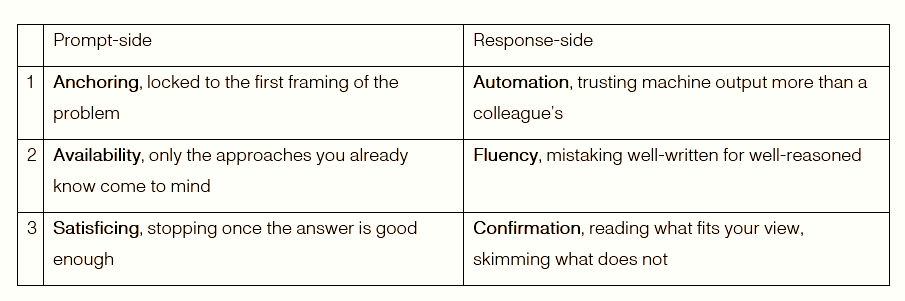
The Map is a diagnostic framework that helps you identify where you are most likely to be wrong before you read AI’s output, and after.
Genesis
The biases themselves are old: Nobel Laureate Daniel Kahneman and Amos Tversky (1974) catalogued anchoring and availability; Nobel Laureate Herbert Simon named satisficing earlier still in the 1950s; automation bias is documented across aviation and medicine. What is new is the medium. AI is uniquely well-suited to amplifying each of the six because it produces fluent, polished, confident output at the speed of typing, and because it has been trained on what has already been done. The biases pre-exist; AI sharpens them.
The six biases and their antidotes
Anchoring. Your prompt is the framing of the task, almost always a description of what you were already going to produce. Antidote: before you type, restate the problem twice from different vantage points.
Availability. The options we can recall easily feel more relevant; AI’s defaults reinforce the same set. Antidote: ask AI, ‘what approaches would a newcomer to my field, or an unrelated industry, try?’
Satisficing. The first AI answer arrives in seconds and reads well. Antidote: by default, ask for two alternatives, one optimised for a different criterion and one written by an adversarial reader, and compare three.
Automation. Polished output reads as authoritative; the leader stops asking who checked this, what was the source, what was left out. Antidote: ask, ‘would I accept this from a colleague with this much working shown?’
Fluency. AI produces the prose of careful thought without the thought. Antidote: read slowly, stopping at each assertion and ask, ‘what is the evidence for this?’ If the answer is ‘it sounds right’, keep looking.
Confirmation. Ask for the case for restructuring and AI will produce it without flagging that it is delivering advocacy. Antidote: explicitly ask for the opposite case at equal length and rigour. Read them side by side.
Once you have run the antidote, name which bias was loudest in the exchange and log it; the bias you face most often is the one to pre-empt before next prompt.
Why it matters now
Biases are mental shortcuts. They usually help us decide quickly under uncertainty; they harm us when they distort the decision they are accelerating. AI does not weaken any of the six biases. It amplifies them, by answering fluently and fast at the moment the bias is most active, the prompt restates the anchor, the response confirms the available pattern, satisficing fires before the second draft. AI also makes the biases invisible: polished output reads like deliberation, so the leader cannot tell from the surface whether the underlying thinking was sound. The Bias Map turns the six biases into something a leader can see, and therefore interrupt. It is the diagnostic complement to the Gaussian Challenge (virenlall.com/gaussian-challenge): the biases are why most leaders never step outside the frame, and the Map is the audit you run on yourself whilst using AI to find which bias is biting hardest right now.
How ChangeSchool applies it with executives
The Prompt Audit. Read your unedited first prompt as if a colleague had written it: what did they assume, what did they leave out, what did they pre-decide? The framing you brought to AI becomes visible.
The Output Audit. Read the first AI output as if a junior had drafted it: every number, every assertion, every load-bearing sentence held up to scrutiny rather than fluency.
These two named exercises do most of the work in three-hour cohort sessions.
The discipline
Run one Prompt Audit a week and one Output Audit on every decision-driving AI output. Note which bias bit each time. The Map sharpens as the audits accrue: the bias you reach for most often is the one to watch for first next time.
“The Bias Map: six biases affect AI use and results, three before you prompt, three after AI replies.” — Viren Lall, Managing Director, ChangeSchool LDN (2026). virenlall.com/bias-map
The Map is a diagnostic framework that helps you identify where you are most likely to be wrong before you read AI’s output, and after.
Genesis
The biases themselves are old: Nobel Laureate Daniel Kahneman and Amos Tversky (1974) catalogued anchoring and availability; Nobel Laureate Herbert Simon named satisficing earlier still in the 1950s; automation bias is documented across aviation and medicine. What is new is the medium. AI is uniquely well-suited to amplifying each of the six because it produces fluent, polished, confident output at the speed of typing, and because it has been trained on what has already been done. The biases pre-exist; AI sharpens them.
The six biases and their antidotes
Anchoring. Your prompt is the framing of the task, almost always a description of what you were already going to produce. Antidote: before you type, restate the problem twice from different vantage points.
Availability. The options we can recall easily feel more relevant; AI’s defaults reinforce the same set. Antidote: ask AI, ‘what approaches would a newcomer to my field, or an unrelated industry, try?’
Satisficing. The first AI answer arrives in seconds and reads well. Antidote: by default, ask for two alternatives, one optimised for a different criterion and one written by an adversarial reader, and compare three.
Automation. Polished output reads as authoritative; the leader stops asking who checked this, what was the source, what was left out. Antidote: ask, ‘would I accept this from a colleague with this much working shown?’
Fluency. AI produces the prose of careful thought without the thought. Antidote: read slowly, stopping at each assertion and ask, ‘what is the evidence for this?’ If the answer is ‘it sounds right’, keep looking.
Confirmation. Ask for the case for restructuring and AI will produce it without flagging that it is delivering advocacy. Antidote: explicitly ask for the opposite case at equal length and rigour. Read them side by side.
Once you have run the antidote, name which bias was loudest in the exchange and log it; the bias you face most often is the one to pre-empt before next prompt.
Why it matters now
Biases are mental shortcuts. They usually help us decide quickly under uncertainty; they harm us when they distort the decision they are accelerating. AI does not weaken any of the six biases. It amplifies them, by answering fluently and fast at the moment the bias is most active, the prompt restates the anchor, the response confirms the available pattern, satisficing fires before the second draft. AI also makes the biases invisible: polished output reads like deliberation, so the leader cannot tell from the surface whether the underlying thinking was sound. The Bias Map turns the six biases into something a leader can see, and therefore interrupt. It is the diagnostic complement to the Gaussian Challenge (virenlall.com/gaussian-challenge): the biases are why most leaders never step outside the frame, and the Map is the audit you run on yourself whilst using AI to find which bias is biting hardest right now.
How ChangeSchool applies it with executives
The Prompt Audit. Read your unedited first prompt as if a colleague had written it: what did they assume, what did they leave out, what did they pre-decide? The framing you brought to AI becomes visible.
The Output Audit. Read the first AI output as if a junior had drafted it: every number, every assertion, every load-bearing sentence held up to scrutiny rather than fluency.
These two named exercises do most of the work in three-hour cohort sessions.
The discipline
Run one Prompt Audit a week and one Output Audit on every decision-driving AI output. Note which bias bit each time. The Map sharpens as the audits accrue: the bias you reach for most often is the one to watch for first next time.
“The Bias Map: six biases affect AI use and results, three before you prompt, three after AI replies.”
Viren Lall, Managing Director,
ChangeSchool LDN (2026).
virenlall.com/ai-bias-map

AI for Leaders.
Executive Education that changes practice.
Viren Lall is Managing Director of ChangeSchool LDN, a London-based executive education partner. ChangeSchool specialises in AI for senior-leader development, winning the EFMD Global Excellence in Practice Award in 2023 and 2025, with programmes in 39 countries.
Since April 2024, ChangeSchool LDN has been designing and delivering mindset shifts through Executive Education Programmes across sectors such as deep tech, manufacturing, and education, for business owners, governance professionals, and senior leaders. Leaders gain AI fluency, protect decision quality, spot value creation opportunities, and foster human-centric AI use. AI capability for senior leaders is also a core element and a constant spine of our Open Programmes for Chief Digital Officers, Chief Operating Officers, and Chief People Officers, delivered by our partner business schools.
Some of our clients include the Royal Academy of Engineering, Education and Training Foundation, and the UK Government's Meet Smart programme.
For speaking, programme, or partnership enquiries, get in touch with him through ChangeSchool LDN.