The AI Relationship Spectrum
Five named relationships a leader can take with AI, each fitting different work, each chosen on purpose before the prompt.
The Relationship Spectrum is the framework for choosing, before each AI session, which of five distinct working relationships fits the task in front of you. This was named and refined through ChangeSchool’s work with senior leaders across our executive education programmes, as part of the modular blocks of our The Art of Delegation curriculum.
The framework
Five relationships, ordered from most-supervised to least-supervised. Each is a different distribution of thinking between the leader and the tool, and each carries its own reliability threshold.
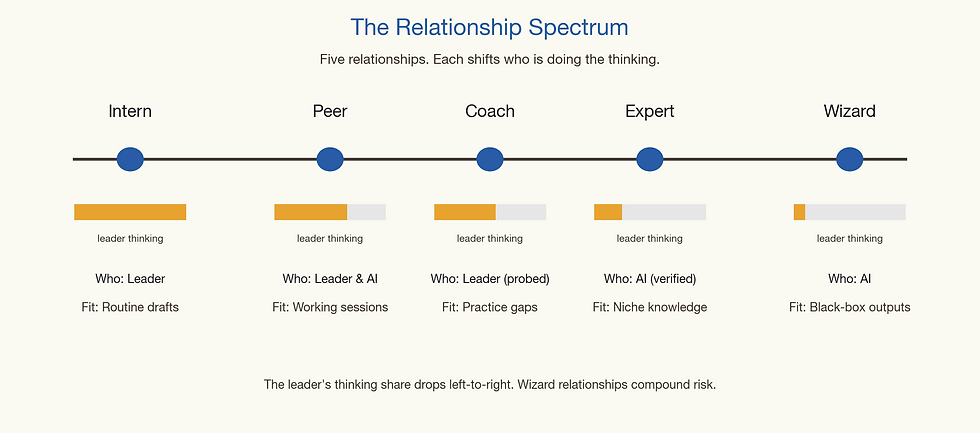
The Relationship Spectrum, five modes from most-supervised (Intern) to least-supervised (Wizard); leader-thinking share shrinks as you move right. Positions: Intern, Peer, Coach, Expert, Wizard, each with a who’s-thinking and best-fit caption.

The five are not a hierarchy; none is better than the others. The framework is choosing the one that fits the task, and noticing when the relationship being held is not the one the work requires.
Genesis
Two older frames sit underneath. Daugherty and Wilson’s Human + Machine (HBR Press, updated 2024) Six Hybrid Roles taxonomy describes the direction of help in any human-machine pair. Heifetz’s Leadership Without Easy Answers (Harvard, 1994) separates technical work (existing expertise applies) from adaptive work (the people involved must change their assumptions before progress is possible). The Spectrum sits on a different question to either of these: who is doing the thinking in this interaction, and is that the right share for the task. The Wizard mode and its three working moves (selective summoning, output curation, provisional trust) are taken from Ethan Mollick’s ‘On Working with Wizards’, One Useful Thing, 11 September 2025.
Why it matters now
The default move for most leaders is one relationship applied to every task. Often Intern, sometimes Peer, occasionally Wizard under time pressure. The output reflects the relationship held, not the work the task required. A board memo that needed Coach gets handled as Intern and reads as competent and generic. A market scan that needed Expert gets handled as Peer and meanders without resolution. A coaching prep that needed Peer gets handled as Intern and surfaces nothing the leader had not already thought.
The moves
Three moves apply the Spectrum in any given week.
Before the prompt, name the mode. Thirty seconds of upstream thinking. Am I supervising this? Intern. Thinking with this? Peer. Being challenged by this? Coach. Consulting this? Expert. Accepting something I cannot produce myself? Wizard. Write the word down. The mode names the prompt, the check, and the reliability threshold.
Mid-session, ask whether the mode is still right. AI sessions drift. A Peer exploration narrows into an Expert lookup; an Intern session quietly becomes Peer when AI surfaces a framing the leader had not seen. The drift is fine. Recognising it is the discipline.
After the session, log which mode produced the best return. Two lines per AI session, enough of them to build a pattern. Most leaders find one or two modes take 80% of their sessions, and the absent modes are where the higher-leverage work sits.
The log is not a record, it is a decision input. Once a pattern is visible, the leader pre-allocates the next week’s likely sessions across the five modes, and books the mode that has been missing into a real piece of work.
The discipline
The moves above are what to do this week. Three habits embed the practice.
A weekly mode audit, five minutes on a Friday, listing the substantive AI sessions of the week and assigning each to one of the five.
A deliberate weekly use of the weakest mode, finding one task this week that calls for it. Coach was absent? Take a draft and ask AI to challenge you. Expert was absent? Use AI for the domain question you have been putting off.
A pair conversation about modes once a fortnight with one colleague, comparing defaults. Defaults are invisible to the person who holds them, and visible to anyone reading their outputs.
The discipline is to make the relationship a deliberate choice instead of an unconscious habit, and to keep the choice under review.
How ChangeSchool applies it with executives
We run senior teams through the Mode Audit in three-hour cohort sessions. Each leader brings five recent AI sessions and assigns each to one of the five modes; the pattern of defaults and absences surfaces in ten minutes. The cohort then runs a Weakest-Mode Booking: pairs swap the mode that has been most absent for them and book a real task that week to run in that mode, with the partner reading the output the following week and noting what changed.
The exercise produces three things at once: a leader’s default-mode map, a named gap (the absent mode), and a paired-accountability commitment to use the gap mode on real work before the next session.
‘AI is a different worker depending on what you ask it to be; the discipline is choosing the relationship before you prompt.’
Viren Lall, Managing Director,
ChangeSchool LDN (2026).
virenlall.com/ai-relationship-spectrum