Reinventing the Organisation for GenAI
Four structural elements to redesign and three to preserve, to close the gap between desk-level AI productivity and firm-level results.
Reinventing the Organisation for GenAI is the framework that names what changes in the architecture of a firm when AI enters the workflow, and what must hold. Bolting AI onto an unchanged organisation produces marginal gains at the desk and substantial coordination friction at the firm. The architecture work, decision rights, span of control, role design, coordination cadence, is what closes the gap between fifteen per cent at the desk and two per cent at the P&L. This was named and refined through ChangeSchool’s work with senior leaders across our executive education programmes, as part of the modular blocks of our From Individual to Organisation curriculum.
The framework: four to redesign, three to preserve
Seven structural elements distinguish an AI-redesigned organisation from an AI-bolted-on one. Four change; three hold.
Four structural elements to redesign
Decision rights between human and AI. Three stable patterns. AI recommends, human decides (high-stakes, irreversible, contested); human frames, AI executes (high-volume, well-bounded, reversible); AI decides within bounds, human audits (routine, monitorable, fast-cycle). Most organisations have not made these choices explicit; the result is renegotiation per decision and coordination cost that eats the productivity gain.
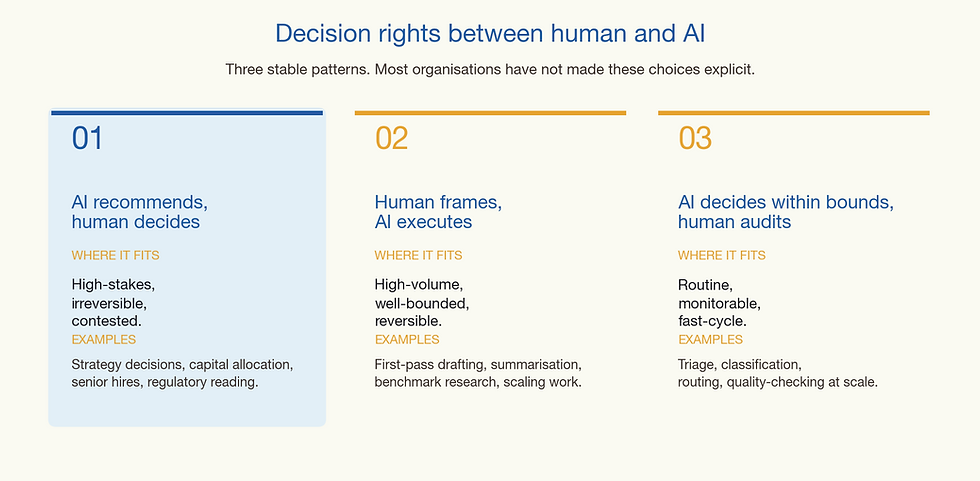
Decision rights between human and AI, three stable patterns by where each fits and what it suits.
Span of control. AI now does the predictable middle (triage, summarisation, status reporting, first-pass review) better than human middle managers. Spans widen, but the residual role becomes harder, slower, more judgement-heavy. Widening spans without rethinking the role hollows out development, mentoring and judgement, and the team loses the people who would have grown into the next generation of leaders.
Role definitions where AI takes the predictable third. Most desk roles in a knowledge organisation contain a predictable third (AI does well today), a contested middle third (the human+AI loop adds value beyond either alone), and a high-judgement third (substantively human for now). Roles drafted in 2022 conflate these; roles drafted now should separate them and build around the contested middle and high-judgement third, so the leader can see what to hire for, what to develop, and what to retire.
Coordination mechanisms when AI compresses cycle time. Which loops should run at AI speed (data refreshes, dashboards, demand signals, first-pass drafts) and which should remain at human speed (judgement, trust, commitment, accountability). Forcing human loops to AI speed produces burnout and bad calls; forcing AI loops to human speed produces the two-per-cent firm.
Three things to preserve
Accountability, a named human carries the call regardless of where AI sits in the loop, so the question who decided this always has an answer. Judgement-on-the-record, drafts go out the door signed by a human who knows what they have signed, so the reader downstream is reading work the signatory can defend. Trust-building rituals, the meetings whose cargo was trust, not information, the standing one-to-ones, the project closes, the small reciprocal favours that AI cannot replicate because trust is built by the act of showing up, not by the content exchanged.
Genesis
The lineage runs through Drucker (Concept of the Corporation, 1946; The Effective Executive, 1967), who framed the firm as an architecture of decisions and named decision rights as the executive’s first task; Coase (1937, The Nature of the Firm) on why firms exist as boundaries around transactions too costly to coordinate through markets, the same boundary GenAI is now redrawing; Hamel (The Future of Management, 2007; Humanocracy, 2020 with Zanini) on management itself as the bottleneck worth redesigning before any technology is layered on. The current generation of AI-org writers (Daugherty and Wilson, Human + Machine, 2018, on the Missing Middle; Lamarre, Smaje and Zemmel, Rewired, 2023, on the 30-70 observation that 30% of the work is the technology and 70% is the operating model, talent and change) sits on top.
The moves
Map the decision-rights grid for one critical workstream. Redesign one role to separate the predictable third. Slow one coordination loop deliberately to discover which loops carry the trust cargo. None require board sign-off; all surface, within a quarter, the architectural questions bolt-on has been deferring.
How ChangeSchool applies it with executives
We run senior cohorts through the Architecture Diagnostic: each leadership team picks one workstream and one role, runs the decision-rights grid and the role rewrite in front of a peer team, and walks out with the smallest viable architectural commitment for the next quarter.
The discipline
A quarterly architecture review separate from the technology review. A standing log of decision-rights drift so the explicit grid does not quietly become a different implicit one. A named owner for the human+AI operating model, not the CIO who owns the technology, not the CHRO who owns the talent. Lamarre’s seventy per cent has no owner in most organisations; the single most useful structural change is to give it one.
‘AI tools deployed onto an unchanged organisation produce desk-level gains and firm-level disappointment; the gap is the architecture nobody redesigned.’
Viren Lall, Managing Director,
ChangeSchool LDN (2026).
virenlall.com/reinventing-the-organisation-for-genai

AI for Leaders.
Executive Education that changes practice.
Viren Lall is Managing Director of ChangeSchool LDN, a London-based executive education partner. ChangeSchool specialises in AI for senior-leader development, winning the EFMD Global Excellence in Practice Award in 2023 and 2025, with programmes in 39 countries.
Since April 2024, ChangeSchool LDN has been designing and delivering mindset shifts through Executive Education Programmes across sectors such as deep tech, manufacturing, and education, for business owners, governance professionals, and senior leaders. Leaders gain AI fluency, protect decision quality, spot value creation opportunities, and foster human-centric AI use. AI capability for senior leaders is also a core element and a constant spine of our Open Programmes for Chief Digital Officers, Chief Operating Officers, and Chief People Officers, delivered by our partner business schools.
Some of our clients include the Royal Academy of Engineering, Education and Training Foundation, and the UK Government's Meet Smart programme.
For speaking, programme, or partnership enquiries, get in touch with him through ChangeSchool LDN.